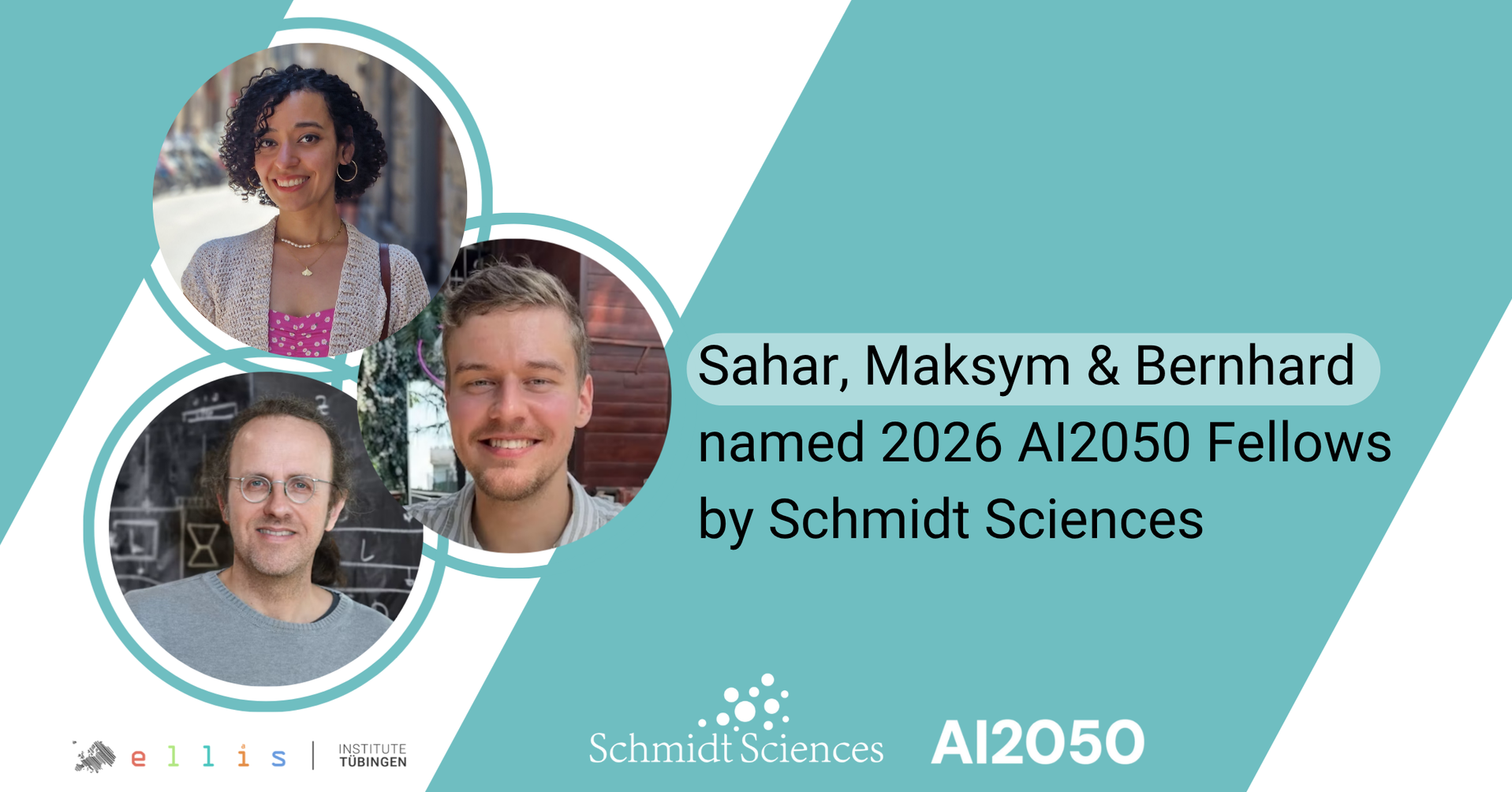


TÜBINGEN, GERMANY - Three Principal Investigators from the ELLIS Institute Tübingen have been awarded prestigious 2026 AI2050 Fellowships by Schmidt Sciences. Selected as part of a global cohort of 28 fellows (6 Senior Fellows and 22 Early Career Fellows), they are working to solve the "Hard Problems" of artificial intelligence to ensure AI develops safely and beneficially for society by 2050.
Bernhard Schölkopf, Scientific Director at the ELLIS Institute Tübingen, has been named an AI2050 Senior Fellow. He is joined by Sahar Abdelnabi and Maksym Andriushchenko, Principal Investigators, who have both been selected as AI2050 Early Career Fellows.
The inclusion of three ELLIS Institute Tübingen researchers underscores the institute's position as an international lighthouse for foundational AI research including safety, agent alignment, and causality.
The AI2050 Projects: From Autonomous Agent Safety to Causal World Models
Sahar Abdelnabi | AI2050 Early Career Fellow
Project: Building Trustworthy Trust: Enabling Safe Cooperation in Multi-Agent AI Ecosystems via Shaping and Controlling Inter-Agent Trust
As AI agents begin collaborating on complex tasks like scheduling and healthcare management, unbounded trust creates risk for collusion and exploitation. Sahar is designing multi-layered defense frameworks - combining architectural safeguards, learned reasoning, and policy controls - to keep multi-agent ecosystems secure, privacy-preserving, and safe from adversarial manipulation.
Maksym Andriushchenko | AI2050 Early Career Fellow
Project: The Science of Measuring the Capabilities and Risks of Recursive Self-Improvement
With AI systems becoming capable of writing code and improving other AI models with minimal oversight, measuring autonomous risks is vital. Maksym is creating empirical evaluation benchmarks (such as PostTrainBench) to track self-improving agents, ensuring they follow safety rules and preventing shortcuts or unethical behavior during recursive training.
Bernhard Schölkopf | AI2050 Senior Fellow
Project: Causal World Models: Towards Computational Epistemology
Moving beyond standard pattern recognition on static data, Bernhard is developing AI models that learn interactively by observing, acting, and experimenting with the world. By integrating causal representation learning and transformer-based inference into "causal world models," his project enables AI to simulate actions, reason about interventions, and support scientific discovery.
Shaping Trustworthy AI for 2050 and Beyond
The selection of Bernhard, Sahar, and Maksym highlights the ELLIS Institute Tübingen’s core mission: advancing fundamental scientific breakthroughs while taking responsibility for the societal and technical safety of future AI deployment.
About the ELLIS Institute Tübingen
Founded in 2023, the ELLIS Institute Tübingen has established itself as a leading center for foundational AI research, attracting top machine learning talent and providing state-of-the-art facilities in Tübingen, Germany. Our mission is to advance pioneering AI research while contributing to the broader ELLIS initiative. By combining fundamental scientific excellence with societal relevance, the institute is shaping the future of AI in Europe and beyond by fostering innovation, interdisciplinary collaboration, and the development of the next generation of leaders in AI science.
About Schmidt Sciences
Schmidt Sciences is a nonprofit organization founded in 2024 by Eric and Wendy Schmidt that works to accelerate scientific knowledge and breakthroughs with the most promising, advanced tools to support a thriving planet. The organization prioritizes research in areas poised for impact including AI and advanced computing, astrophysics, biosciences, climate, and space—as well as supporting researchers in a variety of disciplines through its science systems program.
About AI2050
AI2050 is an initiative of Schmidt Sciences, conceived and co-chaired by Eric Schmidt and James Manyika, that supports exceptional people working on key opportunities and hard problems that are critical to ensuring society benefits from AI. To learn more, visit ai2050.schmidtsciences.org.